Helping individuals, companies, and organizations understand key legal and practical considerations for promoting compliance and making better business decisions in these types of federal, state, and local government contracting matters MORE

The American Bar Association Public Contract Law Section (PCLS) will be hosting the 2020 Public Procurement Symposium from Wednesday, November 18 to Friday, November 20, 2020. This virtual Symposium will feature industry leaders covering a wide range of hot topics in government contracting, including impacts of COVID-19 on federal contracting, investigations and enforcement matters in the wake of national disasters, cyber threats, supply chain threats associated with Chinese entities, biohazard contracting, and energy performance contracting. In addition, on Saturday, November 21, the PCLS will host its Fall Council Meeting. Not only will it address the business of the Section but it will include Thought Leaders Discussions on Section 889, the Cybersecurity Maturity Model Certification (CMMC), and the Executive Order 13950 on Combating Race and Sex Stereotyping.

Register and find more information here.
 

The Contract Disputes Act (CDA) governs claims under FAR-based Government contracts. More than forty years after its enactment in 1978, we are apparently still not all in agreement as to when the time for filing a claim has lapsed. On October 23, 2020, the complaint in Northrop Grumman Corp. (NGC) v. United States, Case 1:20-cv-01447-MHS, was filed at the U.S. Court of Federal Claims (COFC). In the complaint, NGC appeals three Government claims seeking the return of money from NGC as a result of segment-closing pension cost adjustments. Because many reading this blog know the complexity of government contract cost accounting, I will try to put what is alleged to have occurred in plain English.

In 2002 and 2003, NGC acquired business segments from Litton Industries and TRW. The complaint alleges that NGC operated these segments, and in the course of their operation the Government participated in funding the NGC pension plan by paying allowable and allocable pension plan costs under negotiated government contracts performed by the segments in question. NGC subsequently sold the segments and calculated its pension liabilities and funds. Because NGC is subject to government cost accounting standards (CAS-covered), it must comply with various accounting standards and reporting requirements. In complying with these requirements, it determined that there was a pension plan surplus arising from the sale and it was required to report to the Government. The complaint alleges that NGC submitted its recalculation of the pension surplus to the Government back in 2004. The submission was audited by the Government and the parties engaged in back and forth communications over a period of years. The Defense Contract Audit Agency (DCAA) submitted its Audit Report to the Defense Contract Management Agency (DCMA) and NGC submitted its response to the Government in July and August of 2009, respectively. However, it wasn’t until 2019, 15 years after NGC submitted its report, that the Government issued two final Contracting Officer decisions containing three Government claims against NGC. In the Government claims, the Government apparently seeks a greater share of the surplus than NGC had calculated. The Government also included a debt demand and demand for payment, and referred the matter to the Defense Finance and Accounting Service for collection.

In its COFC filing, NGC appeals these final decisions and challenges the Government claims as time-barred, as well as being erroneous on the merits. NGC alleges that the CDA statute of limitations, 41 U.S.C. § 7103, is 6 years from date of accrual of the claim. It further alleges that the time for claim accrual occurred on the date when all events that fix the alleged liability were known or should have been known pursuant to FAR 33.201: in 2004 when NGC reported its pension cost calculations, or at least no later than July 2009 when NGC submitted its response to the DCAA Audit Report. The complaint also alleges that the Government’s calculations of the pension cost surplus and amounts in its claims are not correct.

Irrespective of the merits of the CAS issue, contractors should be closely watching the case as it unfolds. The case raises important questions regarding exactly when the time for asserting a claim arises. The accrual and timeliness of any claim, including a Government claim, are matters about which contractors of all types need clear standards. The CDA provides that contractor and Government claims must be timely asserted. If the Government knew, or should have known, of the basis for bringing a claim, it needed to file a claim within 6 years of that date. The Government, under the express language of the CDA and FAR, is not supposed to sit on its hands while the clock runs out.

At their best, the mentor-protégé programs administered by the Small Business Administration (SBA) are programs whereby large business mentors may partner with small business protégés—providing the small business with resources, knowledge, and an overall enhancement of capabilities. The program also provides that, under certain circumstances, the mentor-protégé team can also jointly venture to compete for small business set-aside contracts for which the protégé qualifies—without triggering the joint venture affiliation rules that would otherwise render the joint venture too large to compete as a small business.

On October 16, 2020, the SBA published its final rule consolidating the mentor-protégé programs, as well as amending certain other government contracting regulations. We previously reported on the proposed rule regarding the SBA’s intention to consolidate the 8(a) Business Development (BD) Mentor-Protégé and the All Small Mentor-Protégé Programs, on which the SBA received 189 comments. The majority of the final rule’s provisions will go into effect on November 16, 2020—except for those provisions amending 13 C.F.R. § 127.504 which pertains to the criteria for qualifying as a women-owned small business (WOSB) or economically-disadvantaged WOSB, which went into effect on October 16, 2020.

Essentially, with regard to the mentor-protégé program, the rule merges the 8(a) BD Mentor-Protégé Program into the All Small Mentor-Protégé Program, such that the former is eliminated as a stand-alone program and is now subject to the same regulations as the latter. To this end, the rule makes the following notable changes:

  • The final rule eliminates the requirement that SBA review and approve an 8(a) joint venture before it may be awarded an 8(a) set-aside contract.
  • The rule establishes a unified staff to coordinate and process mentor-protégé applications, which will allow for more consistent treatment and reduce unnecessary burdens and confusion.
  • The rule also provides that mentor-protégé joint ventures formed under the program are no longer subject to the three-in-two rule, which restricted mentor-protégé joint ventures to only three contracts in two years. Now, joint ventures under the revised mentor-protégé program may be awarded any number of contracts within the two years following the date of first contract award.

Though, in its proposed rule, the SBA had considered limiting the size of mentors to those firms having average annual receipts of less than $100 million, ultimately the SBA decided against this restriction and it is not included in the final iteration of the rule.

The final rule contains other government contracting amendments. Significantly, the SBA now will require offerors under certain unrestricted multiple award contracts (MACs)—i.e., those not issued against a Blanket Purchase Order under a Federal Supply Schedule (FSS), which are subject to separate rules—to recertify their size or socioeconomic status for each small business or other socioeconomic status set-aside order issued thereunder. This change is meant to tighten an existing loophole by eliminating the circumstance in which a business certifies as small when the MAC is first awarded and grows out of this status for subsequent orders but still retains the ability to continue receiving small business set-asides under that MAC. Similarly, the final rule will allow size or socioeconomic status protests relating to set-aside orders where the underlying MAC (again, other than those issued under a FSS) was issued on an unrestricted basis.

It is important to keep in mind that this rule, spanning over fifty pages in the Federal Register, contains many nuanced changes to the SBA’s contracting efforts. While this article highlights the more noteworthy provisions, there are other changes as well. If you have questions about the final rule and how it may apply to you, contact the author, a member of the Government Contract and Investigations practice group, or your Stinson counsel.

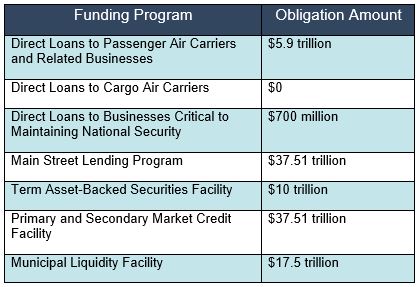
The COVID-19 pandemic hit the United States in 2020 and Congress responded with legislation to provide a variety of forms of relief to small and large businesses and nonprofits, as well as individuals. In addition to providing relief under vehicles such as the Small Business Administration’s Paycheck Protection Program (PPP), Economic Injury Disaster Loans (EIDL), Payroll Support Program and Coronavirus Relief Fund, the legislation established the Special Inspector General for Pandemic Recovery (SIGPR) to actively audit and investigate the application, issuance and use of these funds to ensure that they were properly sought, disbursed and used.

The scope of the funding programs covered by the SIGPR is quite large:

For government contractors, this is a familiar activity—where concerns of potential waste, fraud or abuse regarding government programs or contracts are raised, government auditors have the right to step in to review the contractor’s books and records, to interview personnel, and otherwise investigate the allegations. Contractors found to violate the terms of their contracts in this regard may be referred for prosecution under statutes such as the civil False Claims Act (cFCA). The violation of the cFCA carries specified damages, including repayment, assessment of damages for each false claim, as well as treble damages, and the risk of referral for suspension or debarment from government contracting for a period of years.

For those unfamiliar with the cFCA, but who have availed themselves of PPP or EIDL funds, or otherwise sought government funding, the SIGPR now carries out these same types of functions for the above pandemic relief programs.

The SIGPR’s first quarterly report to Congress was issued on September 30, 2020. The SIGPR has been busy gearing up and entering into partnerships with the other Inspectors General (IGs), as well as the Financial Crimes Enforcement Network, U.S. Attorney’s Offices, the Department of Justice (DOJ), and the Securities and Exchange Commission, to carry out its mission. It has also launched a website, to facilitate the reporting of information on suspected waste, fraud, and abuse by whistleblowers who might seek recovery for being the first to report on fraud under the pandemic. The SIGPR reports that it is conducting 21 preliminary investigations into allegations of improper activity—seven have been referred to other IGs and one is being worked in partnership with a U.S. Attorney’s Office.

News reports indicate that fraudulent activities relating to the pandemic relief and recovery programs are also being uncovered by the DOJ and U.S. Attorney’s Offices, and state investigators. For example, on October 14, 2020, the DOJ reported that four individuals were arrested and more than $1.2 million in cash was seized in a “wide-ranging, ongoing joint federal and state investigation into a significant number of unemployment insurance claims submitted to the Rhode Island Department of Labor and Training, and elsewhere, for benefits funded in part by the Coronavirus Aid, Relief, and Economic Security (CARES) Act.” The press release alleges that the individuals used stolen personal identifying information to file these fraudulent applications for funds. Earlier in October, DOJ also reported that it indicted a Mr. Sah for $24 million in PPP fraud, including wire fraud, bank fraud and money laundering counts. Mr. Sah allegedly spent more than $17 million in PPP loan funds on “lavish personal expenses” looking at the PPP as “his own personal piggy bank, treating himself to not only millions in cash, but several luxury vehicles and properties.” The money came from allegedly fraudulent applications for PPP funds filed under various business names with different SBA-approved lenders, seeking funds to pay the payroll of “employees.”

Previously the SBA announced that it would be engaged in full audits of all PPP loans of $2 million or more, as well.

Given the above, those who sought and/or received federally-funded pandemic relief would be well advised to ensure their records are up to date and that any applications for funds or for relief from funds, and expenditures of funds are being made consistent with the requirements of the implementing legislation. They also should watch for future audit requests.

If the first rule of proposal writing is “give the agency the information it asks for,” the most important corollary is “make the proposal easy to understand.” In other words, clarity and consistency is key; avoid anything in your proposal that might raise questions, confuse the evaluators, or otherwise detract from your message that you deserve to win the award. The recent Government Accountability Office (GAO) decision in MicroTechnologies, LLC, B-418894 (October 7, 2020) underscores the enduring importance of not relying on the agency to do your work for you.

The matter involved the award of a task order for IT support services to SMS Data Products Group, Inc. (SMS) by the Department of the Air Force, United States Space Force. The request for proposals (RFP) contemplated the issuance, on a best-value tradeoff basis, of a fixed-price, indefinite-delivery, indefinite-quantity (IDIQ) task order. It provided that proposals would be evaluated considering two equally weighted factors, price and technical. The technical factor included two subfactors, staffing approach and management approach, with the staffing approach being the more important of the two.

Several companies submitted proposals in response to the solicitation, including SMS and MicroTechnologies, LLC (MT). Both received acceptable ratings under the staffing approach subfactor, and outstanding ratings under the management approach subfactor, but SMS’s proposed price was almost $3.5 million less than that of MT. Based on that, the agency determined that award to SMS would result in selection of the proposal offering the highest technical rating and lowest price. When MT learned of the award to SMS, it filed the instant protest, arguing that the agency improperly evaluated its proposal and, as a result, made an unreasonable source selection decision.

The GAO began its discussion by noting that it does not substitute its judgment for that of the agency when considering protests of an agency’s evaluation of proposals but instead reviews the record to determine whether the evaluation was reasonable and consistent with the solicitation’s evaluation scheme and applicable statutes and regulations. It then identified the two principal proposal documents the RFP required offerors to submit: a staffing matrix and a labor category description document. The staffing matrix consisted of a table listing the proposed labor categories, the number of full-time equivalents for each category, whether each position identified would be staffed by the prime contractor or a subcontractor, what qualifications were applicable for each position, and what security clearance level was applicable to each position. The labor category description document was to detail the qualifications, job responsibilities, educational level, and experience requirements for each labor category identified in the staffing matrix.

The record revealed that MT had been assigned a significant weakness because (i) its staffing matrix included information about the security clearances of certain positions that did not meet the requirements of the RFP; and (ii) the information provided in the staffing matrix conflicted with information about the required security clearances for the same positions that MT provided with the labor category descriptions. In its protest, MT contended that the agency acted unreasonably in assigning its proposal the significant weakness because it contained no more than purportedly “minor inconsistencies” in detailing the security clearance requirements for the positions in question. It also claimed that its labor category descriptions contained the correct security clearance information that demonstrated the proposal’s compliance with the RFP. Finally, MT pointed out that its proposal included resumes that also identify the correct security clearance requirements for the positions. Thus, MT essentially argued that the agency should not have downgraded its proposal for the inconsistencies because the proposal still contained sufficient information for the agency to have found it compliant.

The GAO disagreed. It noted that every offeror is responsible for submitting an adequately written proposal and bears the risk that the agency either may downgrade its proposal during evaluation, or find it unacceptable, where the offeror fails to demonstrate compliance with all of a solicitation’s requirements. Here, the record showed the evaluators assigned the significant weakness because the inconsistency in MT’s proposal introduced a concern about whether or not the proposal met all of the RFP’s requirements. The agency also noted that, while MT unilaterally chose to submit some resumes with its proposal, they were not required and, therefore, were not reviewed in detail. On these facts, the GAO concluded the inconsistency reasonably could lead the evaluators to have a concern about whether, in fact, MT was proposing to meet the RFP’s requirements. Finding no basis to object to the agency’s assignment of the significant weakness, in part, because of this inconsistency in the MT proposal, GAO denied this aspect of MT’s protest.

The moral of this story? It’s much better to make sure up front that your proposal clearly and consistently “delivers the mail” than to rely on the agency to pore through your proposal to piece together the information you were required to provide. To be sure, in some cases agencies may decide to go above and beyond in an effort to understand your proposal. But you can’t rely on them doing so and the GAO will not bail you out by second-guessing an agency’s decision not to.